
Generation rarely lands perfectly on the first try. A banner sits on a face, a line runs half a second long, the source is horizontal. The usual answer is "regenerate and pay again." Here you edit by hand, and re-assembly costs nothing.
Decorate: the AI’s plan becomes yours
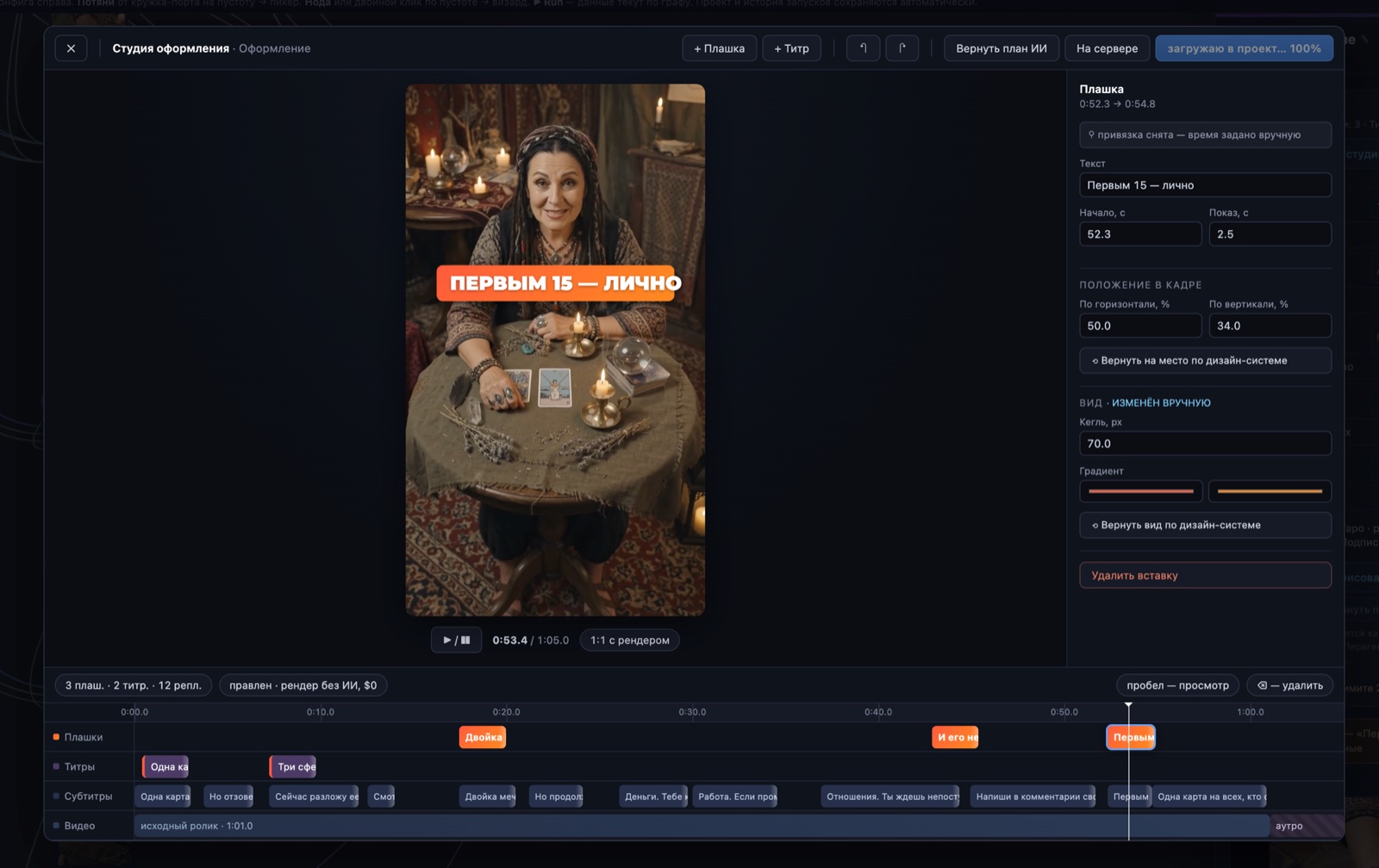
The Director proposes a decoration plan — where and when banners, titles, subtitles, and the outro appear. In the studio that plan stops being the AI’s plan and becomes the project’s document: you edit the text, the timing ("Start" and "Show"), the on-screen position, the font size, the gradient. Drifted off-brand? The "restore to the design system" button puts it back the way it was.
Montage: video and sound on one timeline
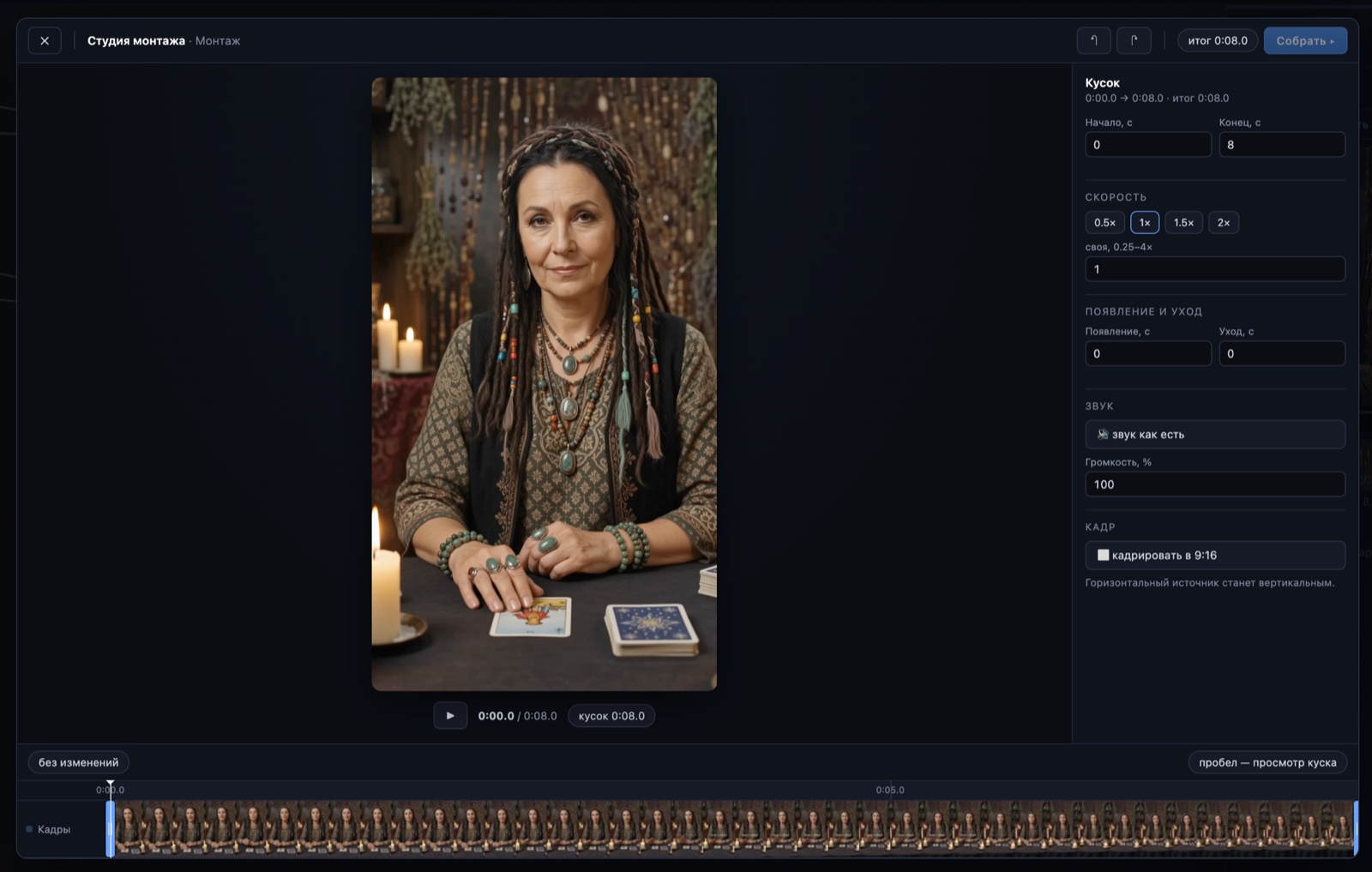
Video fragments share one timeline: each has its own in/out points, 0.25×–4× speed, fades, and framing. Sound fragments are placed by hand in time, while each video’s native audio can be kept, lowered, or muted. And the key thing — crop to 9:16, 1:1 or 16:9: a horizontal source becomes vertical — or the other way round.
Not right? Hit Run again — the whole thing, at the full price of generation. Even just to nudge the banner over by a centimeter.
You move the banner, trim the clip, crop to the format you need — and re-assemble. Render without AI, $0: not a single paid model call.
The timeline is sacred: the ban is addressed to the machine. LLMs and assemblers don’t touch it — a human edits it, explicitly and visibly.— the studios’ principle
How it works — step by step
- The AI proposes. The Director sets the decoration plan and the generator produces the clip — as a starting point, not a verdict.
- You open a studio from the node. Decorate for graphics, Montage for the clip. A real-time preview in the video’s own format.
- You edit by hand. Text, timing, position, font size (Decorate); clip order, sound, trim, speed, fades, and cropping (Montage).
- You re-assemble for $0. The render runs without AI — not a single paid generation; the finished clip returns to the project.
Build your own hero in Vini Studio
A cloud AI video generator: from an idea in words to a finished clip with sound, 9:16 or 16:9. The project is in closed beta — I am looking for authors and partners.
Get started in the studio →Sign in with Telegram or Google. No account needed in advance — it is created for you.